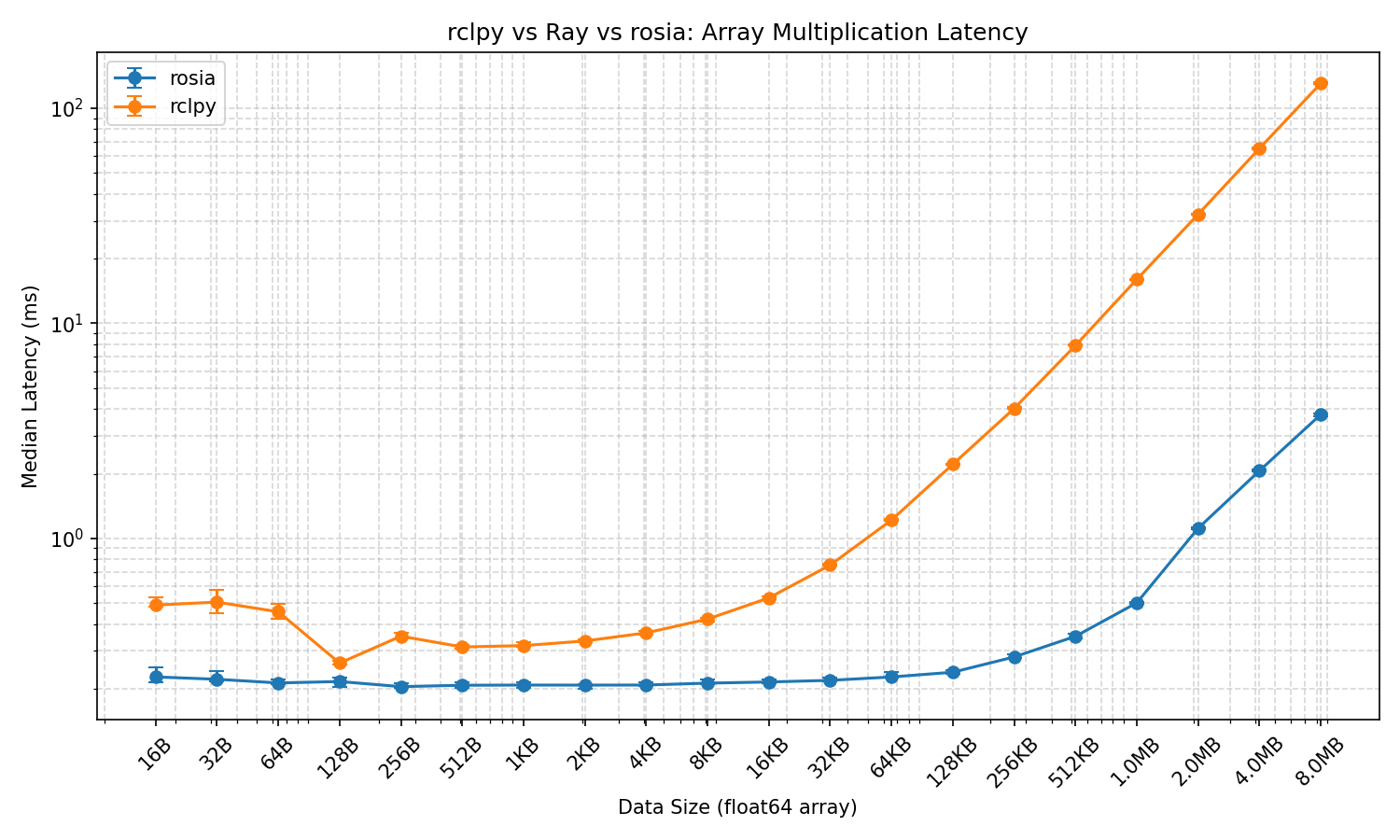
Latency Benchmark
Setup
This benchmark measures round-trip latency of array multiplication across three frameworks: Rosia, ROS 2 (rclpy), and Ray.
Task
A sender node sends a float64 numpy array and a scalar multiplier to a multiplier node, which multiplies the array element-wise and sends the result back. The latency is measured as the time from sending the array to receiving the result.
Pipeline

Sender ──(array, scalar)──► Multiplier ──(result)──► Sender
- Rosia: Two nodes connected via input/output ports in a feedback loop.
- ROS 2: Two nodes communicating via pub/sub topics (
array_dataandarray_result). - Ray: A remote actor with a
multiply()method called viaray.get().
Environment
- Machine: MacBook Pro with Apple M4 Pro chip
- Container: Docker (ARM64), based on
ros:humble
Parameters
- Array sizes: 2 to 1,048,576 elements (
2^1to2^20), corresponding to 16 bytes to 8 MB offloat64data. - Warmup: 20 iterations per array size (discarded).
- Measured iterations: 20 per array size.
- Metric: Median latency in milliseconds.
The % faster column shows how much less time Rosia takes compared to ROS 2, calculated as (ROS2_median - Rosia_median) / ROS2_median * 100. For example, if ROS 2 takes 10ms and Rosia takes 2ms, the result is +80%, meaning Rosia
completes the same task in 80% less time.
Results
On average, Rosia is 64.9% faster than ROS 2.